The World’s Largest Airports: Current Titans and Mega-Expansions
When measuring airport size by land footprint rather than passenger throughput, a clear hierarchy emerges. Massive hubs rely on vast property reserves to accommodate sprawling runways, logistics zones, and future terminal developments.
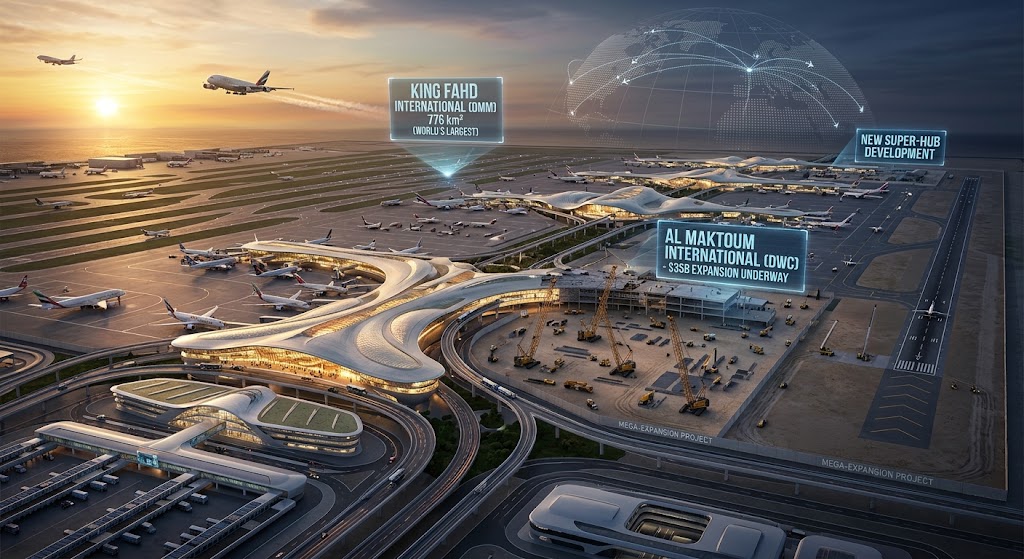
The Top 5 Largest Airports Today (by Land Area)
| Airport Name | Location | Footprint | Overview |
|---|---|---|---|
| 1. King Fahd International (DMM) | Dammam, Saudi Arabia | 776 km² | The world's largest airport by physical area, encompassing a footprint larger than neighboring Bahrain. Much of its massive reserve area remains undeveloped desert for future industrial and logistical growth. |
| 2. Denver International (DEN) | Denver, Colorado, USA | 135.7 km² | The largest airport footprint in North America, intentionally designed with wide runway separation to handle simultaneous operations in severe weather conditions. |
| 3. Kuala Lumpur International (KUL) | Selangor, Malaysia | 100 km² | Built within a former agricultural estate, KUL’s vast master plan includes multiple terminals, a massive free commercial zone, and extensive aviation logistics facilities. |
| 4. Istanbul Airport (IST) | Istanbul, Türkiye | 76.5 km² | Opened as a mega-hub bridging Europe and Asia, featuring a grand unified terminal structure built across a sprawling megasite. |
| 5. Dallas/Fort Worth International (DFW) | Texas, USA | 69.7 km² | Operating virtually as its own self-contained city, DFW sits on a massive land tract equipped with seven runways to support its role as one of the busiest global hubs. |
Mega-Projects: The Next Generation of Global Hubs
While the current top five cover immense geographic areas, a wave of multi-billion-dollar developments is set to redefine physical capacity and passenger volume.
1. Al Maktoum International Airport (DWC) – Dubai, UAE
- The Project: Dubai approved a massive $35 billion expansion of Al Maktoum International Airport at Dubai World Central.
- Scale & Capacity: Designed to eventually cover over 140 km², the site will feature five parallel runways and 400 aircraft gates.
- Impact: Once fully completed, it will become five times the size of current Dubai International (DXB) and is engineered to process up to 260 million passengers annually, making it the primary hub for Emirates.
2. King Salman International Airport (RUH) – Riyadh, Saudi Arabia
- The Project: A $30 billion transformation integrating the existing King Khalid International Airport into a giant multi-runway super-hub.
- Scale & Capacity: Spanning approximately 57 km², the development will include six parallel runways and multiple passenger terminals.
- Impact: Designed to support Saudi Arabia's Vision 2030, the airport aims to handle 120 million to 185 million passengers per year by 2050.
Major Upgrades at Existing Giants
Beyond building brand-new airports, established aviation hubs are undergoing massive infrastructure expansions:
- Jeddah King Abdulaziz International (JED): Undergoing a $31 billion master-plan expansion to build additional terminal space, add a fourth runway, and expand its global logistics hub to accommodate up to 100 million passengers.
- New York John F. Kennedy (JFK): Executing a $19 billion overhaul involving the total reconstruction of Terminal 1 ($9.5B) and Terminal 6 ($4.2B) to modernize international capacity.
- Los Angeles International (LAX): Undergoing over $30 billion in ongoing modernizations, including automated people movers, central terminal area redesigns, and expanded concourses to eliminate severe bottlenecking.