Ultra-long-haul aviation is a high-stakes balancing act between fuel capacity, passenger weight, and human endurance. Modern twin-engine jets are enabling non-stop journeys that stretch over halfway around the planet, redefining global connectivity.
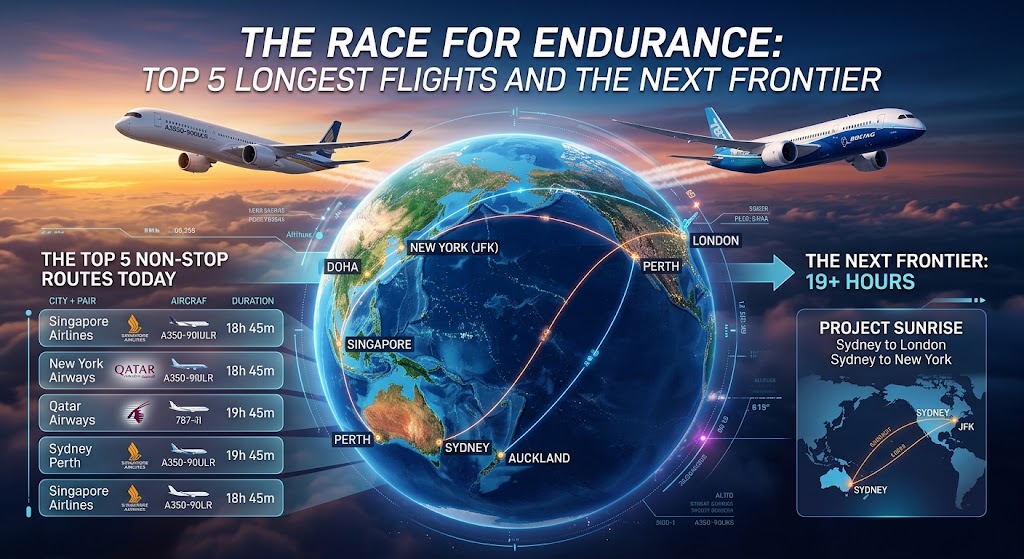
The Top 5 Longest Flight Routes Today
Ranked by great-circle distance, these five scheduled non-stop services represent the pinnacle of current commercial flying:
| Route & Airline | Aircraft | Distance & Time |
|---|---|---|
| Singapore (SIN) – New York (JFK) Singapore Airlines |
A350-900ULR | 15,349 km (18h 45m) |
| Doha (DOH) – Auckland (AKL) Qatar Airways |
B777-200LR | 14,534 km (17h 30m) |
| Perth (PER) – London (LHR) Qantas |
B787-9 | 14,497 km (17h 20m) |
| Melbourne (MEL) – Dallas (DFW) Qantas |
B787-9 | 14,471 km (17h 35m) |
| Auckland (AKL) – New York (JFK) Air New Zealand |
B787-9 | 14,207 km (17h 40m) |
What Makes These Routes Possible?
- Low-Density Cabins: Standard seating generates too much weight for ultra-long ranges. For instance, Singapore Airlines configures its A350-900ULR exclusively with 67 Business Class and 94 Premium Economy seats—completely eliminating standard economy to preserve fuel headroom.
- Advanced Composites: Aircraft like the Boeing 787 and Airbus A350 use carbon-fiber-reinforced polymers to shed structural weight, while maintaining higher cabin humidity and lower effective cabin altitudes to reduce passenger fatigue.
Breaking the Record: The Next Frontier
While Singapore Airlines currently holds the distance record, the hierarchy will shift dramatically as new ultra-long-range platforms complete flight testing and enter service.
Qantas "Project Sunrise" (Sydney to London & New York)
The most anticipated leap in commercial aviation history, Qantas's Project Sunrise aims to connect Australia's east coast directly to Europe and the US East Coast non-stop.
-
The Routes:
-
Sydney (SYD) – London (LHR): ~17,016 km | ~19.5 to 20 hours
-
Sydney (SYD) – New York (JFK): ~16,013 km | ~19 hours
-
The Flagship Aircraft: The Airbus A350-1000ULR. Outfitted with an auxiliary fuel tank and a reduced passenger capacity of just 238 seats across four classes, it includes a dedicated onboard "Wellbeing Zone" for stretching.
-
Timeline: With flight testing underway, non-stop Sydney-to-London commercial flights are scheduled to launch in late 2027.
Other Future Contenders
- London (LHR) to Auckland (AKL): At over 18,300 km, this represents the theoretical limit of non-stop point-to-point travel without a tech stop. While requiring next-generation engine efficiency gains, it remains an ultimate goal for long-haul carriers.
- South America to East Asia: Direct routes such as Buenos Aires (EZE) to Tokyo (NRT) (~18,300 km) currently require mandatory layovers in North America or Europe. Future iterations of ultra-long-range widebodies may eventually bring these multi-leg cross-hemispheric routes down to a single leg.
The Economic & Human Factor
Operating 19+ hour flights isn't just an engineering challenge; it's an operational puzzle:
- Payload Penalties: Extreme wind variations over polar and ocean routes can force airlines to bump cargo or restrict ticket sales to guarantee reserve fuel.
- Crew Logistics: Flights over 17 hours require double flight crews (four pilots) and expanded cabin crew rotas, requiring dedicated, isolated rest compartments built above or below the passenger deck.
As aircraft engines grow more efficient and airframes lighter, the map of point-to-point travel continues to shrink, making 20-hour non-stop journeys the next routine standard in international aviation.