In commercial aviation, passenger capacity is a key metric defining wide-body jets. While ultra-long range dictates flight paths, maximum seating capacity determines how efficiently airlines can move huge volumes of travelers across high-density global corridors.
While Western aerospace giants Airbus and Boeing dominate the modern commercial skies, legacy Soviet manufacturers like Ilyushin and rising global players like China's COMAC are expanding the landscape of large passenger aircraft.
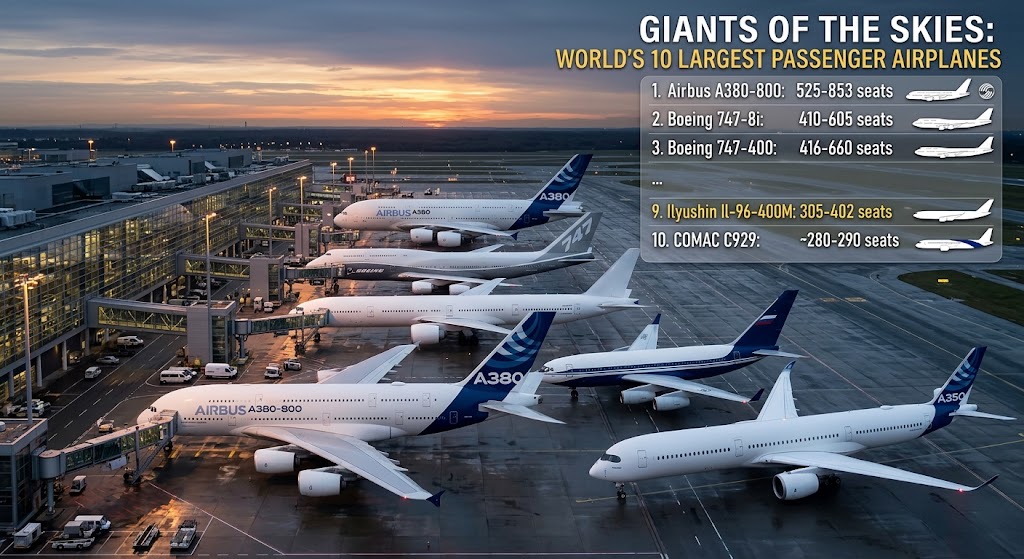
The Top 10 Largest Passenger Airplanes (by Capacity)
| Aircraft Model & Manufacturer | Typical 3-Class Seats | Max Certified Seating |
|---|---|---|
| 1. Airbus A380-800 (Airbus – Europe) |
~525 passengers | 853 passengers |
| 2. Boeing 747-8 Intercontinental (Boeing – USA) |
~410 passengers | 605 passengers |
| 3. Boeing 747-400 (Boeing – USA) |
~416 passengers | 660 passengers |
| 4. Boeing 777-300ER (Boeing – USA) |
~396 passengers | 550 passengers |
| 5. Airbus A340-600 (Airbus – Europe) |
~380 passengers | 475 passengers |
| 6. Airbus A350-1000 (Airbus – Europe) |
~360 passengers | 480 passengers |
| 7. Boeing 787-10 Dreamliner (Boeing – USA) |
~336 passengers | 440 passengers |
| 8. Airbus A350-900 (Airbus – Europe) |
~315 passengers | 440 passengers |
| 9. Ilyushin Il-96-400M (UAC / Ilyushin – Russia) |
~305 passengers | 402 passengers |
| 10. Airbus A330-900neo (Airbus – Europe) |
~287 passengers | 460 passengers |
Beyond the Big Two: Other Global Manufacturers
While Airbus and Boeing account for the vast majority of wide-body airliners in service today, other aerospace nations have developed impressive heavy passenger aircraft:
Ilyushin (United Aircraft Corporation – Russia)
Russia's quad-engine Ilyushin Il-96-400M is one of the largest non-Western passenger aircraft ever built. Designed as a modernized, lengthened variant of the Il-96 wide-body series, the Il-96-400M can seat up to 402 passengers in a single-class layout. It serves both specialized state transport roles and domestic high-density routes.
COMAC (Commercial Aircraft Corporation of China)
China’s aerospace industry has rapidly advanced from narrow-body jets (like the C919) toward wide-body platforms. In collaboration with international partners, COMAC is developing the C929, a long-range twin-engine wide-body airliner designed to seat roughly 280 to 290 passengers in standard configurations, establishing a major new third player in long-haul manufacturing.
Shifts in High-Capacity Aviation
The era of massive four-engine jets is gradually making way for twin-engine efficiency:
- Twin-Engine Dominance: Highly efficient wide-bodies like the Boeing 777-300ER and Airbus A350-1000 carry nearly 400 passengers while consuming significantly less fuel per seat-mile than four-engine legacy aircraft.
- Next-Gen Entry: Platforms like the Boeing 777-9 (777X) set a new baseline for high-capacity twin-engine jets, seating over 420 passengers in standard configurations to bridge the gap left by retiring four-engine airliners.